
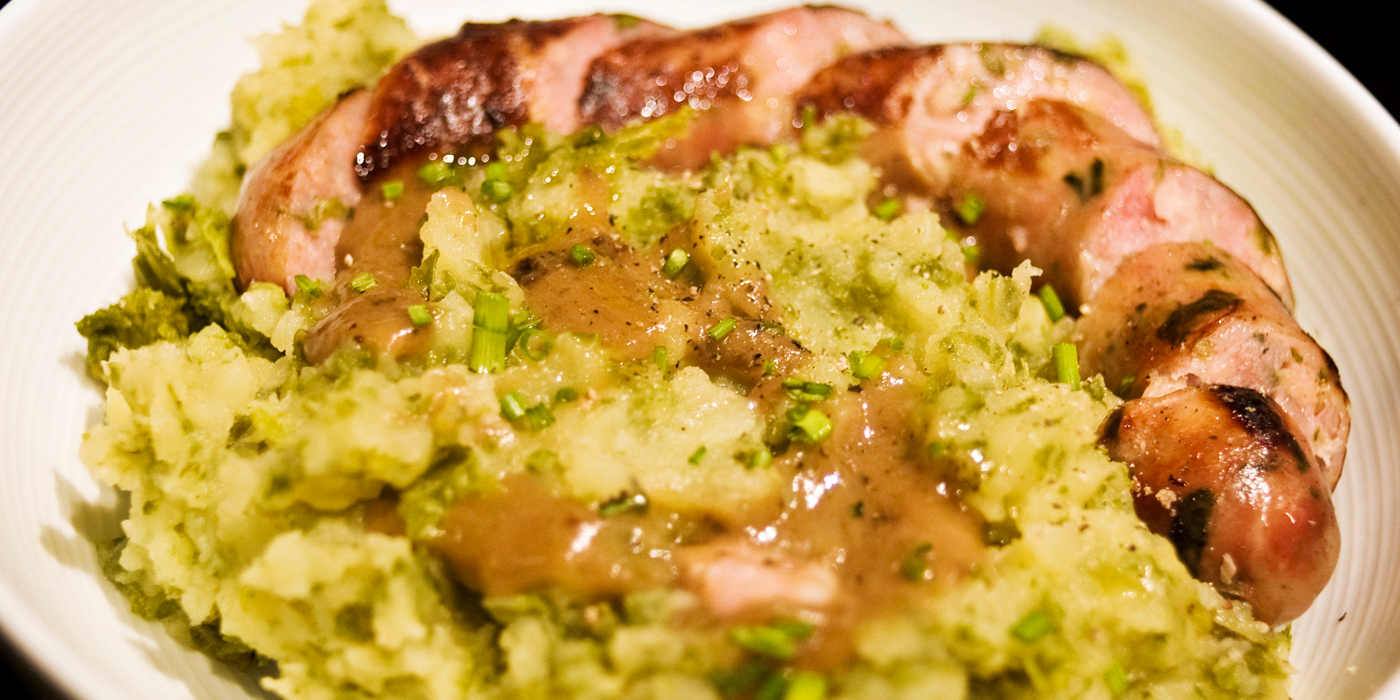
For anyone reading this, it shouldn’t come as a big surprise that Dutch food has yet to sweep the globe. Although pockets of the Dutch can be found scattering the world, delectable Dutch cuisine never seemed to have caught on. “Fancy I pick up some Dutch food on the way home from work?” or “Wow, you have got to try this new Dutch restaurant in SoHo!” are phrases you will never hear uttered.
Isn’t it odd that a nation of traveling, colonizing, patriotic, emigrating folk never managed to sow their own culinary seeds? C’mon, who are we kidding?? Even those emigrated Dutch settlers were thrilled to have found tastier grub! Sure, New York was more than happy to take the Dutch names of Brooklyn (Breukelen), Harlem (Haarlem), Coney Island (from Konijneneiland) and Staten Island — but when it came to Dutch cuisine, they left it at the door (apart from the cheese)!
[divider]Dutch people have 3 very specific ways of preparing food[/divider]
Dutch people like to either:
a) mash the hell out of something,
b) boil the shit out of something, or
c) deep-fry the life out of something!
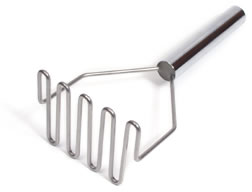
A Dutch person’s best friend
Today we will discuss a), Dutch people’s affinity for mashing. Dutch people love to mash; mash, mash, mash. Case in point, the beloved Stamppot. For those of you unaware of the stamppot, it actually combines 2 of the Dutch cooking specialties a) mashing and b) boiling. First you boil the shit out of various veggies (potatoes, carrots, etc.). Then you mash the hell out of all of them, throw a little sausage on the side, and voila, a perfect Dutch meal!
Ok, ok, now I’m just being cruel, there are many more Dutch dishes! What about the Zuurkoolstamppot (sauerkraut mashed with potatoes) or the Andijviestamppot (endive mashed with potatoes) or the Boerenkoolstamppot (cabbage mixed with mashed potatoes)?! Are you starting to see a pattern here?
The staying power of the stamppot is truly mind-boggling. The dish is said to be one of the oldest, and yet still one of the most popular Dutch dishes, originating in the early 1600s. (Hmm…is that why the Dutch are so tall?) Now, what was that expression… “the beauty of the past is that it is the past”.
For all my sneering at the good ol’ fashion stamppot, I will admit that on a cold, chilly, rainy, grey Amsterdam winter evening – a stamppot does seem to hit the spot. Truly ingeburgerd or lack of options? I haven’t quite figured that one out yet!
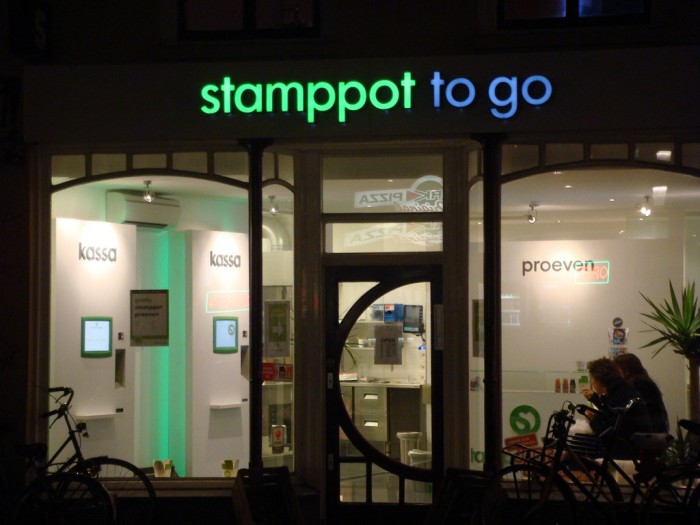
Let’s get some stamppot to go!



Here you touch only half of the subject. Stampot is intentionally mashed (done by the cook), but there is also the mashing everything together on your plate (done by the eater, typically with gravy). The first kind I love, the second kind is a bit weird.
Mashing on the plate, the ultimate must be what my dad calls “Rijsttafelstamppot” and is a practice observed in for example the Dutch Navy performed by the Marines and it involves the “Blauwe Hap” wich is Dutch slang voor Indonesian food.
the opposite also exists: ‘stamppot-rijsttafel’.
It is when you make a couple of types of stamppot (cabage stamp, sauerkraut mash, raw-endevi mash, nice to server in bowls like you would serve italian ice) and seperately make small pieces of meat (baked bacon, meatballs granny style, smoked porksausage, spareribs) and seperately make other toppings (pickled onions, picallily, mustard) etc. Put it all on display on a long table and let your guests help themselves. This is quite a feast and at the same time quite cheap, so when you ask your dutch invites to chip in money for their part of the meal (you are allowed to round it down to the nearest 0,05 ct), they will complement you not only for the food, but also for charging them such a low price only.
I think that it saves the person eating the stuff from having to chew it any longer than necessary. 🙂
Especially because they rather be talking instead of chewing 😉
NOOOOO the mashing on the plate is not “weird”, it is an intensely intimate and special ritual that makes the Stamppot truly fit the eaters desires and personality. For example, when eating Boerenkool Stamppot, my brother makes a point of not only getting the mashed potatoes and boerenkool (preferably with tiny bits of bacon), but also getting the Rookworst, chopping it to the finest bits as humanly possible to achieve, put it in the stamppot together with a royal amount of gravy and spend the next 10-15 minutes carefully mixing everything together so as to achieve the utmost generic and non-identifiable mush possible. This in order to create a dish that has no differences in flavor whatsoever with every bite he takes. That is not weird, that is highly logical and super-efficient! 😉
And how many of you (us) Dutch actually do the table mashing with heaps of mayonnaise!!!! that i thinks might be the weirdest, but best part of it!
Hmph. Philistine. Everyone knows you arrange your stamppot into a ring around a centre depression, in which you pour gravy. We are dike builders, not food processors!
My grandfather used to make a “vulcano” out of his boerkool stamppot. He would make sort of a mountain with a hole in it and in that hole he’d poor the gravy. He enjoyed that very much and it is one of the fondest memories of my grandfather. (That and not wanting to drive backwards in his typical Daf 66.)
Today i had smoked salmon stampot, with leeks and creamcheease with herbs, i can trurly say it was nice
I am second generation Dutch/Canadian. I cook boerenkool for my husband. We actually grow it in our garden and put ii in the freezer for the next two years! He loves it but the only way I can eat it is with lots of bacon and sausage. I cook the potatoes and put the frozen boerenkool on top of it and then mash it all together. I only like it when the kale is not cooked too long and when there is lots of bacon and sausage. I do not need gravy but he likes it. I try to save left over pork gravy as it is the best. Enjoy but I like other foods better!
My father broke many forks because of all the mashing, and yes did the Vulcano thing as well. See
Marc’s message.
I love your conment!
And you get thar delicious gravy taste `till the last bit!
My dad used to call the mashed food on the plate “een lekker prakje”
Mmmmmm!
my Pake called that mashing everything on your plate thing a “plecky”. no idea how to spell that.
they call that a “prakkie”
My dad did this – mash everything together – including the applesauce
Benjamin you are obviously not Dutch. The second part is the best. The gravy (jus) is mixed with whatever is left on the plate to clean it all up. Lovely!!
Indeed I think there is no good translation to the word ‘prakken.’ That’s something only the Dutch do, even to their Italian and Chinese food 🙂
Indeed, prakken is typical Dutch. But why would you prak your pizza or prak your bami? It doesn’t make sense and I’ve never heard of someone doing that. I hope you were joking, because these barbaric people should be deep-fried the life out of them.
I do actually ‘prak’ my bami, spaghetti, chilli con carne and every other dish .. But I guess that’s just me!
Suddenly, the world Prakken sounds exeedingly disgusting in my head. Hahahahaha! Wow! I guess the combination with English really shows the word in it’s true ‘glory’, suddenly making me see it for what it really is.
Also, I never prak, at one point as a kid I decided I liked to cut my potatoes. And of course, the other Dutchies actually thought I was weird for it. 😉
The Dutch practise prakking 😉
Sorry, I couldn’t resist pointing these out to you: http://chicago.menupages.com/restaurants/vincent/
http://www.yelp.com/biz/pannenkoeken-cafe-chicago
When my friends visit here they go back to my hometown and eat at these places 🙂
Well done! But do know that it takes quite a while to cook this, which means the lady of the house spends more than an hour every day on cooking this!
Really curious what you’ve got to say about the deep frying. Didnt know it was typically Dutch until I moved to England. Don’t forget the FEBO!
Thank you for reminding me what country I come from!
You forgot the most important serving tip of the stamppot: het “kuiltje jus”, the dip finish of gravy, the little hole in the stamppot made by the gravy-spoon to be filled with gravy !
My father thought me and now Ive taught my daugher: make a mountain of your stampot. From the top make little roads with your fork; all the way down.
Then make a tiny pool in the top of the mountain for your gravy.
All kids like to do this and makes eating stamppot even more fun!
O yes, our son likes to build the Vesuv everytime we eat it here in Germany !! Het is zo lekker… 🙂
not important to me… we usually never have gravy, only my father sometimes puts gravy on his potatoes, altough I don’t remember him ever putting gravy in his stamppot. I have tried putting olive oil on my potatoes for a while to combat dryness, after cing back from italy where once I had some potatoes that loked like regular boiled potatoes soaked completely in olive oil(central point in italian cooking it seems, everything drenched in oliveoil), wich surprisingly(from how it looked) tasted very good. but after the bottle was empty I quit doing that
Strange. I find “The Original Dutch Pancake House” all over London. Just visited a Chicago suburb and the menu at the pancake house there prominently showed “Dutch treat” “Dutch original” etcetera.
So what do you mean with your starting paragraphs?
Well, pancakes aren’t really haute cuisine, now are they? 😉
But they are really dutch! Also we eat them for dinner sometimes, which other people seem to find weird, since they are a breakfast thing in america (but their pancakes are not the same as pannekoeken…)
They are at least as “haute” as stamppot is :p.
True though, There is a reason why the Dutch words for cooking and boiling are the same.
Well so isn´t pizza.. at least comparable..
o, so pizza’s are the culinary top of the line? :p it’s usually exactly the easy tasty food that gets known in other countries. and also we eat pancakes as dinner(altough here my parents also always put 2 bowls on the table with slices tomato, cucumber and/or pepper to make it a bit healthier)
Might be, but looking at the American kitchen…. Macdonald, burger king, KFC, etc… all the rest is foreign; italian, chinese, japanese, etc..
And to add with all this POFFERTJES!! how good are those (found a Poffertjes stand ones in a small town in Australia, was awesome!)
more of a crepe than what Americans associate with pancakes. It can be cuisine.. there are countless varieties on how and with what you make the real pannekoek/Dutch pancakes.. just saying.
Stampot Boerenkool and Zuurkool are on our menu, even though we live in Florida. Our CSA grows the kale, now if only I could buy an Unox or Hema Rookworst, anywhere!!!!!!!
I buy Jennie-O lean smoked turkey sausage and find it pretty close to Dutch rookworst.
I must say that I think the smoked sausages from Sams club are really good!
Hallo,
Probeer eens een rookworst van de Aldi als je die in de buurt hebt, smaken prima!!!
The “Gelderse boeren rookworst” from the Aldi in Belgium are among the worst of “paper” factory sausages.
try to find Eckrich Original Smoked Sausage (they are made with Pork, Turkey and beef) at Publix or another large supermarket. They just taste like the ones Hema sells..
Polish smoked sausage comes quite close. For imitating ‘boerenkool’ when kale is not available, canned or frozen collard greens do too. Mash thoroughly with patatoes, add fried bacon if you like. Pour vinegar over it and do not forget course mustard.
Really laughed about boiling the shit out of something. Especially boiling the shit out of vegetables is something our (grand)parents would and will do.
A stamppot actually tastes better if you dont boil the shit out of the veggies.
Andijviestamppot is ‘lekker’ if you mash the RAW endive with the mashed potatoes. Flavor the stamppot with curry and stamppot really becomes Dutch ‘haute cuisine’.
Eet smakelijk
I use all kind of eastern spices (like coriander, ginger, hot pepper etc) and soysaus. I “mash” it together with the raw endive, the mashed potatoes and some cheese. Then I put some cheese on top and put it around 25 minutes in the oven until the cheese is melted. It’s great!
my parents make endive stamppot with raw endive, aardappel purree(from powder) and cheesesauce(also from powder), with meat, usually spekjes, mixed trough instead of rookworst served with it. I like it like that, like boerenkoolstamppot too, but not really a fan of hutspot altough I can eat it just for nutrition, but I rather eat my pants than zoorkoolstamppot, had it once and never again.
I agree! the only real dish which is boiled the shit out is our all to famous SNERT
no that’s a dish you wouldn’t even serve you mother in law……
I guess you have never had good snert because the way my wife makes it, it is delicious. Fit for a king.
Made it last month, mother in law loved it 🙂
Agree! Yuk!
Same here 🙂 The second i read that line, the image of my mother and her veggies that are allmost liquified popped into my head. Couldn’t stop laughing…
yes, rauw gestampte andijvie, lekkerrrr lol I’ve been living in America for 11 years now but I need my stamppot (any veggie stamppot) every winter! lol
@Nelleke, trust me on this: Don’t try to bring your own Rookworst to the US. They will find out and you will only just escape a 300 dollar fine for trying to import meat. Of course they will take away your precious Rookworst and your sister won’t be happy.
@Marlies, veggies always tastes better if you don’t boil the shit out of it. Boiling the shit out of veggies is typically something the ‘older’ generation does :).
The young generation boils the food with the lid open, so tastes and nutrient flow out of the pot. And now I mostly see pots whose lid have at least one hole, so you need extra water to prevent burning in.
I feel like frites sauce (which, despite what wikipedia claims, is NOT mayonnaise) belongs here too. I tried for years to replicate it (never successfully), my husband mocked me for it, and my in-laws didn’t believe me about it until we were in Amsterdam and I required them to stop for frites. And then they all looked at me and admitted that I was right all along.
try mixing mayo with regular yellow mustard and a bit of Red wine vinegar.. keep tasting until you like it..
you know you can easily make mayonaise yourself? Take the yellow thing inside a egg (don’t know the englisch word) put some mustard in the bowl with the eggthingy. Take your (hand)mixer and keep adding oil! Don’t be suprised how much oil you need, it’s enormous the main ingredient of mayonaise is oil!
yellow thing inside an egg.
That’s called yolk. 🙂
1 eidooier
1 theelepel mosterd
1 eetlepel citroensap
1 mespunt zout
versgemalen peper naar smaak
1,5 deciliter zonnebloemolie
Laat alle ingrediënten een half uur van te voren op kamertemperatuur komen. Doe alle ingrediënten – behalve de olie – in een kom en klop ze tot een glad mengsel met een staafmixer. Giet er tot slot druppelsgewijs – al kloppend – de olie bij. Bewaar het resultaat afgedekt in de koelkast.
Fun post, thanks for this! But don’t forget about the famous Dutch herring tradition, eaten raw, and the snert (Dutch variant of pea soup). Also I feel that Dutch cheese deserves an entire post for itself…
The herring tradition rules, the Dutch devour them like a pelican eats fish! I’ve been wondering what is used to marinate the fish though…
hear hear lol
I grew up in Overijsel, Nederland and was born near a small village in a boerderij. We had no electricity and no running water. During the summer the turf fed cooking stove went out to the schuur to be thoroughly cleaned and for several weeks (or months) my mother cooked on a one burner petroleum stel. I believe this is the reason the stamppot was invented; to use one pot for everything was the only way to cook. I’ve lived in Canada now for 50+ years and still make stamppot occasionally as do all 3 of my children – it’s comfort food. My favourite is with carrots and fried onions. My aunt made “stim stam” with raw endive and if anyone has a recipe for this I’d love to have it. My mother never deepfried anything, we only saw deepfrying when we moved to the West coast and it was at the markt where one could get patat.
Johanna B.
Stimp-stamp is yummie and really easy! You just cook your potatoes till they are done, make a puree with them with some hot milk + butter , some nutmeg and salt +pepper. Then you add the well washed and chopped endive, just add as much as you like. Some just like the stimpstamp greener then others, we like it nice and crunchy.
Then you season it with some vinegar and add (ofcourse) crispy fried pieces of bacon you there you go!
Johanna,
Stampot met uien en wortels noemen we hutspot, ik kom uit Leiden, en daar is het ontstaan.
toen de spanjaarden in 1875 de stad hebben belegerd, en waren verdreven door de watergeuzen, heeft cornelis joppenszoon op 3 oktober de pot met eten gevonden bij de lammenschans, een kamp van het spaanse leger.
historisch eten dus, wij eten het ieder jaar met 3 oktober.
Thank you; I had read about that and will mention it to my children the next time I make hutspot.
Dear mister Sleijer,
The Spanjards occupied Leiden 3 centuries earlier ! At that time the potatoe was unknown in Europe Foei !
(in Dutch: de Spanjaarden hebben Leiden 3 eeuwen eerder bezet ! In die tijd was de aardappel onbekend in Europa.. Shame on you !)
@frank if you read this… They probably used an other root vegetable (one other then a carrot) instead of potatoes the first times but all works aslong you can mash it it works fine ;p and root vegetables grow fine 😀
Actually, Frank, the Spanish had been in the Americas for a quarter century by 1575, and had introduced the potato to Europe by then.
ik wist niet dat de Spanjaarden in 1875 door de watergeuzen verdreven zijn. In 1574 is Leiden ook door de watergeuzen ontzet.
vergeet de haring en wiite brood niet!
I lived in the Netherlands with a dutch family in a veru small village in Noord-Brabrant. My host dad would always make incredble stamps, and I loved the one with endive too!
You have to boil the potatos and then let them sit for a while to lose water. Then mash the potatos with some zureroom untill it’s creamy and add the thinly chopped endives raw and stir together and let sit for a a few minutes cooking in the residual heat (out of the fire) while you chopp some cheese in cubes. add the cheese, stir and eat fast with gigantic meatballs (gehakt ballen) and gravy (jus)
yummy!!
The carrots and onions mixed with potatoes is called ‘hutspot’. In Leiden, where I’m from, this is eaten on the 3rd of October, when the ‘leidenaren’ were liberated from the Spanish occopation. It is a lovely dish, especially eaten on a cold day!
@Miriam: Before the potato was known in Europe (and The Netherlands), they used parsnips instead for hutspot.
potatoes,, raw endive and spekjes and a little bit of grave from it. Smashed together with boiled eggs. Thats really good and simple food
and YES I am Dutch
We are having stampot boerenkool (kale) tonight. Lekker with smoked sausage and crispy pieces of bacon….Yummie! The other thing of those stampotten is that you throw the potatoes and vegetables in 1 pot and put the sausage on top while cooking.
Try the potatoes, carrots and onion stampot, we call that one “hutspot”.
As a Mormon missionary living in Gouda in the 1960’s we found a place that served very plain food to the local farmers. Wonderful food, huge amounts served family style at trestle tables. Heerlijk! A year later I introduced our mission president to this place and every opportunity he had to be in Gouda at midday he would stop in to have some “real” Dutch food.
Awesome I live in Gouda now… I have no idea what place you mean or if it’s still there. Since it’s decades away back in time (and something like 20-ish years before I was born). I also think I might know or knew some people you’ve met in church or so on your mission… I can’t throw with names in here tho (would like to name some! but can’t because of privacy reasons.)
my friend goes to the Gouda ward, you might know her, Annelies De Haas?
If you are a farmer, working outside in the cold, wet winter you need lots of calories and nothing is better than enough stamppot to feed a family of four in the USA, a small piece of meat, and jus (not gravy, just the grease off the meat).
hah this is indeed so typical! my recent favourite is spruitjesstamppot – brussels sprouts mixed with mashed potatoes 🙂
I have to second Benjamin – making stamppot is one thing, but mashing all your food together on your plate is another. apparently, children are taught to mash something they don’t like to eat (vegetables, generally) with their potatoes and gravy so the taste becomes bearable. some people never get over this habit.
my father praks, my mother doesn’t but sticks a piece of each on her fork. she has said a few times about the opposite of what you say, according to her it’s typical for children to want things seperate on their plate to eat it seperatly. like not mixing the rookworst in with the stamppot like she does, but eating it seperatly, like me and my little brother do. or not wanting the macaroni and sauce-vegetable-meat-mixture together(when I was younger I wanted to eat the macaroni without the sauce, not anymore, but my little brpther wants the sa,e now. while I was already mixing it before he was born I think, so he can’t have gotten it from me
Well you have me rolling on the floor laughing!! My friends never understand Dutch stampot, but in winter give me (undercooked) Cavolo Nero and Mash or Kurly Kale and mash with real british sausages any day!
Have a great weekend:)
The Dutch are better known for their sweets; in the US we often have “Dutch chocolate” and “Dutch apple pie.” Stroopwafels are also lekker. Just say no to overcooked mashed root vegetables!
we had a distant family member and a friend, both from the US, over once some years ago, they brought a mix for brownies(at the time brownies were still largely unknown here, I had never heard of them, by now you can buy mixes for brownies here too), and we were all surpried it said ‘with real dutch cocolate’, while here we never imagine being famous for our chocolate, if we think of chocolate we think of belgium or switserland.
Love the article, and love the comments as I truly learned to love the dutch stamppot during the 10 years I lived in Holland. But as a student amongst culturally broadminded peers, I also learned about the expanding possibilities of the Dutch stamppot. As mentioned before, curry goes a long way. As does adding other non-traditional herbs and spices, exotic vegetables (red bell peppers, cornkernels), fruits (peaches, apricots, pineapples, bananas) and other stuff (pesto). I never liked sauerkraut untill some daring cook put it in front of me with the addition of peaches.
For those who don’t know, boerenkool is kale and its stamppot tastes awfully good on a cold afternoon, with thick diced bacon (forget about turkey low-fat stuff and get a slab of the real thing!).
In the 90’s brought the trend of not killing the food by mashing it 200% but only so much that it would mix to a degree that the various ingredients were still recognizable.
As for the accompanying meat dish, chicken also became a trend. But I will choose a big fat gehaktbal (meatball) or a juicy braadworst anytime over whatever other.
meatballs always make me smile ever since I came to live in America, I am laughing out loud for real while I type. Reason being.. In the first six months of being in America I would make (Dutch style) meatballs for my husband, the first time I did so, he was looking at me as if I was crazy. “This is not a meatball, it’s a football!” lol I explained to him that this was the size I grew up with, not the golf ball sized he was used to. That is NOT a meatball in my opinion lol Now I make them medium sized, to Dutch standards.
OH!
We forgot to mention: Hete bliksem! (=hot lightning, a.k.a. in eastern parts of Holland ‘hemel en aarde’ , heaven and earth, or in the north simply: sweet apples stamppot, or ‘pronkjewail’, jewel.)
Yes, apples. In Dutch potatoes are called ‘aardappels’ which means ‘earth’s apples’ (like in French: pommes de terre)
Served with bacon and bloedworst. Oops.. bloedworst… You could very well make another blog about this. I don’t need to read that one. 😉
Yes! I was gonna mention Hete Bliksem too!
It’s made with sweet, and a few sour, apples, potatoes and diced bacon, and in our house of course we also serve it with smoked sausage and verse worst (we really like our meat!). It’s delicious!
We don’t do bloedworst (black pudding) as we’re not really fans of that.
I went to Holland some time ago.The one gentleman said they’re having heete bliksem for lunch!!
@Johanna Brown: A recipe, really? For stamppot, or stimpstamp? I’m still laughing about that one!
But here goes. Serving 4.
Peel potatoes for 4 persons. Maybe some more, so you will keep a little for a prakje next day 😉
Cook in salted water. While this is going on, dice up a slab of bacon, and let it fry till desired crispness in a tiny tiny pat of butter. If you got a good no-stick pan you can even forget about the butter.
Wash about 1 lb andive, more or less depending on how much you like the greens, and tear or cut up the leaves. If you’re a spoiled brat like me you will like to cut out the center nerve of the green leaves.
When the potatoes are done cooking pour off the water, add a bit of nutmegg (or any spice if you feel adventurous) and mash the potatoes with one or two dashes of milk to desired mashed-ness. I like to add cheese, either diced or shredded, young gouda or edammer makes the best for melting in the stamp.
At the very last moment before serving you can add the endives and the bacon and stir it all through. Of course you could serve this with a rookworst, (like Jenny mentioned <>) but myself, I prefer a gehaktbal with my stamp.
I hope this recipe will be to your liking. It will most probably not taste the same as your aunts recipe from the good old times, but I think you will have a good starting point to go experimenting to find your own unique stimp-stamp.
Thank you. It sounds about right but I’m sure she added vinegar.
I’ll give your recipe a try.
Jo
I add mayonnaise…..secret family ingredient 😉
@ Jo: late response, just found this article. But vinegar is used in alot “stampotten” I always add vinegar to them. My son in law tasted it last week, liked it so much, he made for his parents also week later (as in yesterday)… Best use the herbal-vinegar (brown) white one is ok, but not as tasty. But to stimp-stamp, i dont use vinegar all the time, sometimes i use Picallily!! Try that, it has the vinegar taste, but also sort of freshness. Be aware not to take pically right out of the fridge, it can cool all down alot because you allready added the vegetables cold. sometimes i heat al up on stove and stiring alot, but put in oven with cheese over it also an option.
And what about all the oil they pour over everything (including overboiled and mashed vegetables). I awoke quite ill after having a vegetarian meal in a Dutch restaurant last year. Just beats me why they’re such a healthy population (although perhaps they cycle it all off).
I`m afraid pouring oil over food is a typical vegetarian habit. Who needs oil when you have jus?
We never use oil in our house… But we’re not vegetarians, so it might be a typical vegetarian thing…
hahaha I was thinking the exact same thing. I never have oil over my food, not the Dutch food that is. Jus is the way to go, no need for oil at all.
The Pannenkoeken Cafe in Chicago is pretty popular. Every time I go there it is jammed full of people, and the waiting list is full of people waiting 30+ minutes. The food tastes good and looks fairly similar, but like you said they left the Dutch at the door. They took American ingredients and made it look like Dutch food. The batter could be from a box of Aunt Jemima. I attached the url to a picture I took of one: P
I look forward to my next visit to the Netherlands. Real Dutch pancakes for dinner sounds good!
Endive mash and Dutch meatballs :
http://www.youtube.com/watch?v=95hF0Qrjk58
’nuff said …
The Dutch cuisine abroad is probably better known for its sweets. Its been said that the Dutch settlers introduced the donut (our oliebol became the donut). And I wouldnt be surprised if the word cookie derives from the Dutch word koekje (almost pronounced the same).
So, Dutch sweets give a a whole new ring to the expression a Dutch treat 🙂
@marlies
The word cookies derives from the Dutch word koekje. Best example of a Dutch derive is coleslaw. Prenounced exactly as koolsla. Going back to the early Dutch of New Amsterdam in 1650.
source: Russell Shorto – The Island at the Center of the World: The Epic Story of Dutch Manhattan and the Forgotten Colony that Shaped America
Yet again you hit the nail on the head! You missed one thing though, shallow-frying the daylights out of things. I refuse to eat any kind of meat unless it’s absolutely cremated. Oh, and the burned bits at the bottom of anything used for cooking are always the best. Letting the foodie types have the main part and scraping the residuals from the bottom when nobody is looking is so much more gezellig, and ensures nothing is wasted too! (Very important). Keep up the good work, I love your blog. X
Have you seen Anthony Bourdain’s episode in Amsterdam? He was totally not impressed by the pannekoeken and broodjes.
What I remember of Bourdain’s show in Amsterdam was mainly him visiting a coffeehouse, talking with the proprietor about the different flavors available, and saying that it would be entirely against network policy for them to show him smoking anything that’s illegal in America. Then there’s a commercial break, they’re back at the same place, and he’s obviously totally baked. And then they go out drinking. I think that was also the show where he went to some outdoor restaurant in a garden by some water, but that could have been another city in Europe.
Dutch food is just plain simple because most of our ingredients are that good 😉
And what about coleslaw?
My father was Dutch, and I grew up with a couple of those stamppots — kale and carrot. They’re winter comfort food at their best.
As far as Dutch food making its way around the world, NYC has a frites place and the product tastes just like the frites carts in Amsterdam, with that same incredible double fat mayo on top. That said, I live in a part of Michigan where every other town has a deeply Dutch name (Zeeland, Overisel, etc.) and although there are restaurant chains known for their bland, overcooked food, there isn’t a true Dutch food restaurant. Although you can get olie bollen at Tulip Time so long as you go to the Fat Ball cart. Thanks for your blog!
My husband is Dutch. I’m Africian American. He turned me onto this blog and, of course, he laughed uproariously while doing so. Yes, staampot. I’ve tried it–both eating it and making it. Ahhhh, the mashed concoctions that the Dutch have devised. Can’t really say I’m a fan. But then again, what the hell is a mashed potato if not, well, mashed?!? I’ve known my hubby for five years and have been married for two and half of those five, yet I still marvel at the things that go into the mouths of my Dutch in-laws whenever I visit them in Voorhout, which is usually two or three times a year. But on the flip side of the coin, I’m sure things that I (we, as Americans) eat seems a bit off kilter to them as well. So I take it with a grain of salt….I just try not to mash the shit out of it!
I lived in the US for a year and I was astonished at their eating habits as well. As much as our cultures are alike, they are just as much different from each other. I never understood the vast variety in casseroles that all had the same base ingredient: Campbells canned, condensed (or cream of) mushroom soup. And it adds NO flavor at all. I am sure whilst being there I enhanced the prejudice about the Dutch putting salt on everything before tasting it, because I knew these dishes were as tasteless as my grandma’s butt. Nevertheless there are certain foods that I do miss and cannot get here. So I guess it has to do with what you’re used to. (gosh I miss donutholes!)
Yep! Dutch food is good! Thanks for sharing!
There actually is a “new & hip” restaurant right in NoHo, NYC: http://www.vandaagnyc.com
There’s another Dutch restaurant in NYC as well.
The Pannenkoeken place in Chicago isn’t very good, they confused Dutch with Danish and put Havarti on the pannenkoeken. They’re also only open for breakfast, Dutch people usually eat pancakes for dinner. Also, it just doesn’t taste that good. Vincent, same city, is far better but a bit overpriced, and sometimes too salty.
If you treat Dutch food as food cooked in the Netherlands before the nineteen-twenties, yes, it’s probably close to the above. But New Dutch cuisine, just like New American cuisine, is a totally different story. The influences and fusion of ingredients from former colonies and current neighbors grew into some amazing variety of foods. There are Turkish versions of the banketstaaf and often Stamppot Zurekool is prepared with curry powder and fried bananas.
Also, it’s not like potatoes are originally Dutch, they didn’t become the main food staple until the 18th century when the grain prices had risen steeply. Tea was popular before potatoes were. Hutspot (mashed potatoes with carrots, onions and some kind of meat) was a dish that the Spanish introduced during the 80 year war – though back then made with parsnip instead of potatoes.
But even if you look at “traditional” Dutch food there’s lots to be savored, like mustard soup, white asparagus, north sea shrimp, a variety of breads and cheeses, parsnip dishes.
Nonetheless, funny article.
You’re nearly right, but not completely. Not the Spanish introduced the “hutspot”, but the “watergeuzen” (sea beggars?), who set free the city of Leiden after nearly one year of siege, in 1574. They brought herring and white bread, and hutspot. Indeed no potatoes in it, not known in Europe at that time.
Actually, Stien is right. I live in Leiden and we do celebrate the ending”of “the Leiden Siege” every octobre 3th with Haring and Wittebrood, because the Geuzen brought them to the starving Leiden people.
The Hutspot was found in an abandoned Spanish camp (Lammenschans) by a Leiden boy, Cornelis Joppensz, who sneaked out of the city on octobre 3th 1574. He brought it back to the city.
See also: http://en.wikipedia.org/wiki/Siege_of_Leiden
I make you right, my Mum is from Leiden and we have this celebration every time I see her. For her, being shipped to Ireland as a small child during WW2, then to London as a teenager hasn’t stopped her remembering the food that sustained her during the hard times. I vividly remember potatoes and carrots mashed together with watery milk and sometimes onions too, as my staple diet when I was small, always in a huge pot. I’m 6′ 2″ and nothing special in NL. Good food!
Stien, nice comments, and totally to the point concerning modern Dutch cuisine.
Since getting married to a Dutchy I’ve been introduced to all kinds of stamppot. I’m ashamed to say I kind of like it.
LOL@Citizen_Stu !
I would just like to point out that Boerenkool is made with Kale and potatoes instead of cabbage and potatoes.
Here is what to eat with the Stampotten….
Zuurkool (sauerkraut)…. either (Rook)Worst , or spekjes m speklapjes – or gehaktbal.
Hutspot with ..Hachee or spekjes/speklapjes or klapstuk
Boerenkool ..met ribbetjes + rookworst & alittle (iets) azijn or gurkens over it on your plate
Wittekool with Ribbetjes – worst or gehaktbal
Andijvie rauw er door stampen with uitgebakken spekjes & speklapjes.
Spruitjes met draadjesvlees.
Hete Bliksem (peers & apples) rundvlees or gehakt
To any of these stampotten you can add some cheese extra gravey, or different meats..its what you prefer.
“EET SMAKELIJK”
I see a lot of people saying that most of this is common is England or the US. But what about us down here in Australia. Dutch food a rariety. I can’t find good enough receipes to make anything as good as it is in The Netherlands. As a child I didn’t realise how much of an oditiy it was to have mashed potatoe and carrot with nearly every meal. That and having dinner at 6pm.
I only now realise how much different our dinners really are. Did you know pancakes are a breakfast food? Weird. And dinner is normally immediatly followed by desert? Myself and my Dutch friend both didn’t realise this until given desert straight after dinner at a party. We were both full and ready to wait, yet everyone else was wondering where the icecream was.
And this weird habit of eating at least after 7pm. I’m hungryyyy!!!!!!!!
By the way, boerenkool is not quite cabbage, it is kale. Whilst it is true that this is a member of the brassica family, it does have its own name.
Funny that for a national dish, there’s very few restaurants that will sell stampot (only really the tourist ones in Amsterdam, plus Stampot To Go chains which are starting to appear). The curious tourist will more likely have to befriend a local and convince them to invite them back for dinner.
Actually, most restaurants in rural areas like the northern provinces do have all sorts of stamppotten, along with snert and bruine bonensoep (brown bean soup?) on the menu. So for tourists who come to Holland to bike and walk along the nature trails, there’s plenty of opportunity to get a taste of typically Dutch food.
Het grootste voordeel is de tijds winst van het “prakkie” je hoeft niet meer te Kouwen
het is hap slik weg,binnen 10 minuten heb je de “rotzooi” naar binnen gewerkt,een bord pap na en “klaar is kees”. Dus we zijn eigenlijk te lui en hebben een hekel aan “Kouwen”
M.v.g.
I am not Dutch but I put things in mashed potato all the time. I’d also like to point out that cabbage in mash is not only Dutch but also English called Bubble and Squeak as seen in The Wind In The Willows when Mr Toad is in jail. Except it is taken a step further and then friend and voila (nearly) all three things you listed in one dish. Granted it is not a big a staple as the Dutch stamppot.
What shouldn`t be forgotten is that the Netherlands were probably – for a time at least – the biggest importer (and reseller) of exotic spices in Europe. Many uses of fine spices in European staple food were introduced in the Netherlands. There is in fact no real distinction between the Dutch (and Belgian) and the French tradition apart from some minor favourings of certain ingredients. French just sounds fancier.
Dutch cuisine took a dip after it was decided that the Dutch girls` schools should teach their students to cook ‘economically’ i.s.o. ‘fancy’ (i.e. traditional). One or two generations later, girls` schools were abolished (and why not, if they didn`t even teach children to cook properly) and boys and girls were sent to the same schools.
Overcooking comes from a time when the water had to be boiled to make it safe for consumption. Since fuel was precious, this was done while cooking the food in it. These days, average Dutch tap water is the safest and cleanest in the world, as is its distribution network.
Deepfrying the life out of something isn`t part of Dutch cuisine. You may find street vendors that do it, but having street vendors is a far stretch from not having haute cuisine.
That aside, a good stamppot is a thing of beauty. The most exquisite is stamppot raapsteeltjes, made with the small stems that grow on turnips in early spring, only available in a few weeks in spring, if at all, because too much rain in this period will make the raapsteeltjes ‘watery’ and worthless. The turnip stems are only blanched (dipped in boiling water, not cooked).
One of my favourites is stamppot rode kool, mash with red cabbage. Red cabbage is traditionally mixed with sweet apples and spices. This dish has it all! It`s a harmony of tastes with the bitter of the cabbage, the sweetness of the apples, the aromas of the spices and the savoury of the ‘spekjes’, and at the same time has the combination of consistencies: the creaminess of the mashed potatoes, the (not over cooked!) pieces of cabbage, the soft appleparts, and the crunchy ‘spekjes’.
Andijvie stamppot, as has been mentioned, is made with raw endive. And it is one of the few where the vegetable leads instead of tails the name.
For stamppot boerekool you have to wait until the kale have been frosted over. This is ancient knowledge, that was proven right just a few years ago. Kale (and brussels`sprouts as well) will form a biological anti-freeze when the plants are exposed to freezing temperatures, which tastes sweet.)
Zuurkool stamppot knows a lot of vatiations. Many people add a sweet ingredient, usually fruit. Raisins are commonly used in this way. The zuurkool is heated though, not cooked.
As for ‘spekjes’: This is salted and diced pork-belly, which many refer to as bacon. It is fried in its own fat (left in a shallow pan over a small flame without adding butter or oil) and used in all stamppot except for hutspot, which – although very similar – isn`t really stamppot. Both the fried bits and the fat are added to the pot. The fat gives a savoury meaty flavour without adding much in the way of meat. The fried bits are crunchy and contrast well with the consitency of the mash. Most stamppot uses only the white, lardy ‘spek’ (the cheapest). Zuurkool stamppot notably uses the leaner, red, more meaty kind. Hutspot uses beef (so it is less ‘working class’) traditionally ‘klap-stuk’, but today this is often substituted with stir fried minced beef.
In todays more prosperous times, portions of meat are added on the side. Typically ausages (Grm Bratwurst) and speklapjes (slices of porkbelly) with zuurkool stamppot, and other kinds of sausages and meatballs with the others.
In short, stamppot isn`t just mash with anything. Its mash with leafy vegetables (mostly cabbages) and something that substitutes ‘real meat’. Hutspot (or hutsepot) with carrot, onion and beef, should be regarded seperately, as should also be clear from its history, as recounted by Stien.
No, if you want a much older traditional Dutch staple, try the dish (actually a variety of similar dishes) sometimes referred to as ‘Hollandse rijsttafel’, ‘Bruine bonen met rijst’ or ‘capucijners met spek’: the ancient combination of beans (or peas) and barley, in which the barley has now been replaced with rice. Also prepared with ‘spekjes’ and often with pickles on the side (sour or bitter taste in a traditional dish is usually a clear indication of age, since these flavours have since fallen out of favour).
And instead of having pancakes for dinner (not that uncommon in mainland Europe) it might be worth pointing out that the Dutch have nasi goreng (literally fired rice) for dinner, when everyone knows that nasi goreng is breakfast! (Its leftovers from the previous day – rice, meat, vegetables – throwen together and stir fried in a wadjang.) 🙂
erm.. that would be fried rice, not fired rice.
Great response, one side note; ‘endive’ actually translates to witlof, not andijvie. Go in to a store in the US or UK and try to find endive. If you’re lucky you will find wiltof. Besides that. thnx for pointing out us Dutch have more depth to our kitchen then meets the eye. 🙂
I live in Ontario, Canada and I use escarole for the “stamppot andijvie”, that is more like the Dutch andijvie than endive.
with all respect but I think you are wrong. Endive IS andijvie. I buy endive here on a regular base. I am Dutch and it looks and taste the same as “andijvie” .
Witlof, I think is chicory. witlof: a vegetable with white leaves that taste bitter.
Mashed…endive? o_O”
In US English, there are two different plants that get called “endive”. One has loose green curly leaves and is also called “escarole” https://en.wikipedia.org/wiki/Endive . Another has flat whitish leaves that form a dense head like lettuce and is also called “Belgian Endive” ; look at the Wikipedia page https://en.wikipedia.org/wiki/Chicory#Leaf_chicory which says that in Dutch it’s called “witloof”. Neither one is traditional in most of the US, but they’re becoming more commonly available, particularly the Belgian endive which is often sold along with red radicchio lettuce.
Hi. I really like this blog. I’d like to add to the mashed food fetish: appelmoes (apple mash) and snert (overcooked thick pea soup).
DINNER!
In my opinion you forget all the other vegatables. Green beans with Komkomber and Runderlapjes. We also have a wonderfull dish called Hungarian Goulash. There are also the beetjes with buttersauce and spekkies. As for the stampots you forgot about the “blote billetjes in het groene gras” White beans and grean sliced beans who were put in salt to stay fresh all winter in a Keulse Pot. they were blend and mashed together with patatoes and on the side a nice piece of stove meat. I do think we have that no more, but I still remember that and liked it very much as child. We also had “Hete bliksem” Apples and patatoes and spices. Every kids favorate. And then there are the desers. Fresh made vanilla pudding with blackberry sauce. Yoghurt and chocolate pudding topped with fruit that was in season. The all favorite bittercookies pudding. As you see there is more to dutch cooking than just mashing it.
Don’t forget the Rijstepap (milk, rice, vanilla boiled together, and topped with sugar, cinnamon and the juice of red berries).
My grandma used to make a dish that included mashed potatoes, kale, and roast pork. She called it ‘mouse’ or something close to that. Do you have any idea what the Dutch name for it is?
@Tom DeWitt: Mouse is ‘muis’ in Dutch. Mashing food together (or ‘prakken’) for a little child is called ‘een muisje maken’ translate this as “make a little mouse’ of the food. Strange, but true …
Maybe moes (pr.muese), which is the literal translation of mash. ‘Tot moes stampen’ = to stamp to a mash.
Moes, eastern dutch (achterhoek) for boerenkool
In Groningen, “stamppot mous” = boerenkool (kale) stamppot
My daughter is an expat Canadian living in Holland. Before she left, my daughter proudly cooked (her first attempt) a pot of stamppot of potatoes, carrots and sausage. We were told the story of how this meal is a Dutch staple before we dug in. I bravely put a smile on my face and lied about how great it was. If this is a staple in Holland, no wonder they are so lean.
Actually good stamppot is delicious, the quality of the ingredients and seasonings is crucial. In Belgium it’s called Stoemp. Dutch sausages are generally excellent and don’t exist on this side of the Atlantic.
I just thought of this the other day. When I was in Riga, I found snack cups of dried mash&bacon, of the ‘add boiling water’ variety. I have a vague notion of having seen them in other countries as well, although I never paid any attention to them until then, but never in the Netherlands. Even though you can buy ‘instant noodles’ and ‘instant macaroni’ in every variety imaginable, there is no instant snack mash in Dutch shops.
I also saw a kind of dairy in Riga shops that I had never encountered in the Netherlands, though I forget what is was called. It tasted like Dutch kwark, but it was much firmer. I originally mistook it for butter, until I noticed it came in fruit flavours. My Latvian friends encouraged me to try it, but severely warned me to stay away from the milk they sold in the shops.
@ablabius: I’m sorry to inform you that “instant mash” does excist in the Netherlands. It’s called “Wonder-stamppot” and comes in de vararity Hutspot and Boerenkool …
and it is yucky, bah. Always a carton box taste to it. No way people can experience a real stamppot from a box.
I know some Dutch people who like to mix up any other food too because they are so used of having mashed up food. I take as an example, Indonesian food. Which is probably why the serve this so-called ‘Indonesische rijsttafel’ at Indonesian restaurants in Holland, a meal consists out of rice and small portions of Indonesian dishes. I guess it allows Dutch people to do what they love to do, put everything together in their plate and mix them together until you won’t recognize what’s actually in that plate anymore. 🙂
Well. guess again. You do not mash the several dishes together. You take the small bites you fancy and eat them along side the rice. It is a kind of sharing the food with the others at the table. That’s why most times yoiu have to order for two persons at least. Having a “rijsttafel” alone is no fun at all!
You should also write something about the Dutch not using salt and being afraid of other spices too 🙂
But we use far too much salt in the Netherlands! It was just in the news a few weeks ago… But no, not many other spices. Although I do like nutmeg, cinnamon, cloves, vanilla and chives for seasoning.
Uhm, have you been to the US? That’s where spices went and died….
If a chef in a restaurant is good, and many of them in the Netherlands are very good indeed, you shouldn’t need to add salt.
no idea where you get that from..
Finely cut and mashed food allow a variety of advantages. It allows you to use partially spoiled meat and vegetables because it’s invisible the bad parts were cut out. Everyone gets a little bit of the most expensive part (the meat and grease). Finely chopped vegetables cook with far less fuel. It can all be cooked in one pan, and the cutting can be done with one kitchen knife while everyone can eat it with a cheap wooden spoon. Nobody else has food like this from the 1600 because the dutch had such a strong middle class compared to everyone else at that time. The food from most other countries comes from the elite, not yeoman farmers.
I’m not Dutch but this had me crying with laughter, so much that I woke myself up laughing.
Meanwhile our stamppot eating, deepfrying, boiling-the-shit-out-of-food country is one of the top 10 world economies. I guess stamppot makes a good base for well, anything really. And let’s not open the discussion about dishes around the world that are based on traditional Dutch dishes.
It’s typical old-fashioned Dutch food, or typical for meat eaters maybe. I’m a vegetarian and hardly ever mash up , and I’m certainly not afraid of spices. I don’t recall every haven eaten mashed food at any of my friends either.. but then again, I don’t seem to fit into the stereotype of Dutch people you describe. And I wish I’d see a man in red pants, they all wear jeans or boring black or grey pants, no colours to be seen!!
I’m a lanky Dutchman living abroad (Hong Kong) and I love your blog. Anytime I get a little sentimental about my home country I visit your page. Today I found a small error. You write: “Wow, you have got to try this new Dutch restaurant in SoHo! [is a] phrase you will never hear uttered”. That’s not true. In Hong Kong, just north of SoHo, the restaurant ‘The Orange Tree’ has been serving Dutch cuisine for over 15 years. Their hutspot is amazing.. 🙂
FWIW there was for a number of years a Dutch restaurant on the fringe of Melb. Australia; also a Dutch grocery, and Dutch pancakes called poffertjes have become something of a fad at food markets.
But I loved reading this piece. I grew up on stamppot and fried meatballs along with pea soup and rookwurst (which I still make).
Bogus… There are masses of great restaurants in the Netherlands and with a relatively high number of Michelin stars. I live in Sydney now and don’t see much difference in food culture let alone what I saw in the US. The daily ‘prak’ is quite similar around the globe as are the great restaurants you’ll find in any country too…
Oh I laughed my head off with the ‘prakken’-comments. Every child I know grew up with his meal ‘geprakt’ and lots of eldery still prak away happily. I remember my grandfather sitting opposite me at the diner table every sunday, even ‘prakking’ his fries, with his salad and meat together. Afterwards mashing the whole mixture up with his clappering false teeth…… and his mouth open. Oh… happy days.
Ok, stampot is lovely I do agree, but, come on, it doesn’t take rocket science
to make it? boil potatoes, veg and fry/boil some meat? not really adventurous at all, but still the same, tastes great
Because my girlfriend has Turkish roots, I even serve stampot with sucuk. Tastes great !
Your article brought back fond memories – my mom, from the day we emigrated to South Africa in the fifties until her dying day at 85, made stamppot. It was always much enjoyed, especially when we got home starving after swimming lessons. Regrettably my English/Motswana husband does not like ‘baby food’. The geprakt I recently experienced first hand when a Dutch friend visited us here in Botswana mashed and cut up all the food on his plate, even the salad got thoroughly geprakt! It’s healthy for one to chew you know!
I love Stamppot! As for the first post, I have to mention that I’m one of those people that mashes the food on their plate. Potatoes mashed with gravy, so good!
hoi, i like stampot, espacially the boerenkool
I’m Dutch and I live in Germany. I have great trouble findin Andijvie here. Occasionally my local supermarket sells it, but most of the time they do not. Very frustrating!
As a matter of fact, before the 19th century Dutch cuisine was much more copious than it is now known for, thanks to having a wide range of colonies. Yet, after gradually losing several of those colonies to the English and Dutch economy going on a downward slide, in the course of the 19th century Dutch cuisine got simplified. Bourgeois cuisine got modeled after the cooking habits of the poor, which resulted in the predominance of stamppot.
By the way, American donuts originate from Dutch oliebollen. American apple pie derives from Dutch appeltaart.
Oh, and if you don’t mind, it’s ‘karnemelk’, not ‘karne melk’.
Out at a rather good restaurant in Melb. Australia last night and there was hutspot on the menu!
Dutch cuisine isn’t that great yeah, except when it’s below zero degree celsius. I hardly ever eat it – and if I do, I eat modified versions of it. Baking on the other hand …. We are TERRIFIC at baking! Speculaas (with or without a filling of almond paste), stroopwafels, arnhemse meisjes, knieperties, boterkoek, drie-in-de-pan (that’s a bit like american pan cakes), spekkoek, nonnenvotten, hemelse modder, bitterkoekjes, arretjescake, Friese duimpjes, kletskoppen, vlaai, kruidnoten, pepernoten, poffertjes and so on.
Actually, there is a Dutch restaurant in the East Village in New York, and it is *edit* was pretty cool: http://newyork.seriouseats.com/2010/08/vandaag-east-village-dutch-more-than-gin-genever-bar-opening-review.html
They even serve ‘bitterballen’ in a fancy way. Which is really odd from a dutch perspective.
Our culinary skills are getting better by the way. Both our 3 michelin star restaurants are getting international acclaim. We’re getting past the ‘appelmoes’
My English friends are still proud to say they ate ‘bitter balls’ when they went to Holland!
Hahaha. This explains why my Dutch father loves to mash his entire plate of food into one big lump. A friend living in the Netherlands once told me that “the Dutch are masters at cooking every cuisine except their own.”
stamppot was invented in time of war. People didn’t have very much food, so they decided to make something simple and compact. I am dutch and I eat stamppot a lot. I love it, maybe because I’m used to it.
It’s so not true that we deep-fry everything. I life in Manchester right now and a lot of people think that but it’s really not true and trust me, I’m really Dutch! 🙂
I was married to a Dutchman for 13 years. His mom made stampot. She used potatoes, green cabbage. Boiled them together with smokies on top. I so love it! I make it about 2-3 times a year. But I use kale chopped onion and potatoes. I put several different types of sausage in it, like farmers sausage, smoked pork, smokies, bacon, I always put in a variety of different kinds of sausage. Boil it all together, remove the meat. Mash the potatoes and kale. And voila! A delicious, hearty meal! Dill pickles and pickled beets go well with this. My grown kids love it and so does my present husband. Say what you want about the dutch. Their cooked is not fancy, however, it is cheap, tasty, and filling.
stew (stamppot ) is not the same as mashing (Prakken) in the Netherlands.
mashing (Prakken) is done on the dinner plate
stew (stamppot ) making is done in the kitchen I usually pan.
mashing (Prakken) http://altijdovereten.nl/wp-content/uploads/spruitenstampot.jpg
stew (stamppot ) http://www.ziezozuid.nl/images/stories/stamppot-amsterdam-de-pijp-albert-cuyp.jpg … http://www.dekooktips.com/pic-rec/hutspot.jpg
Not just mashing but building forts with moats out of our food – the gravey goes in the moat of course … 🙂
What about an ovendish of witlof (chicory) with ham and cheese? My American cousins (2nd degree) always want that whenever they are visiting me in The Hague.
And as desert they want poffertjes with lots of butter and icing sugar.
Actually there have been a few quite excellent and, for a time, very popular Dutch restaurants in New York City: NL on Sullivan Street and Vandaag on 2nd Avenue and 10th Street among a few others. The Netherlands, perhaps in particular the southern provinces, has a great culinary tradition and those southern provinces have much in common with the gastronomically sophisticated Belgium. The number of MIchelin-starred restaurants in the Netherlands is comparable with Switzerland. Mashing can be delicious and anyone who doubts the value of Dutch cuisine should spend a week in South Limburg or Zeeland. It’s a fine place for a gastro-tour.
Boerenkool = Kale NOT Cabbage.
Nothing wrong with a good old stamppot with smoked sausage or a juicy gehaktbal I say! Some nice gravy on top and you have a truely good Dutch meal. The day after some proper ‘snert’. Yummy!
I think stamppot is delicious, actually. But it’s not stew, I believe stews are “stoverij”. I also think it’s true that “boerenkool’ is kale and “kool” is cabbage.
I think that “boerenkool” is curly kale, not cabbage. Though this might be UK English?!?
What is this shit about deepfrying! Stampot with gravy, mustard or both is heaven! What are the comments on English food then! I crave stampot, far away from home and occasionally delight my family making it, The potatoes are not the same though! 🙁
I was raised for quite a few years by my grandparents. We’re talking just after WWII. They were very old fashioned, true Dutch, and the main staple was boiled potatoes, braised meat, jus that wasn’t thickened, basically what the meat was braised in, and boiled veges (overcooked). Everyone would ‘prak’ their potatoes and mix the veges through it. Making a hole in the middle for your jus and then playing with your food making little canals, was fun. Stamppot was only made occasionally. Boerenkool with rookworst, zuurkool with spek, hutspot (onions/carrots) with meatballs or spek, stamppot made with red beets, raw chopped onions and spekkies, and one of my favorites, often cooked in summer, iceberg lettuce chopped fine, onions, potatoes, spekkies, and a soft boiled egg. A hole in the middle for the bacon fat… Fridays my oma always substituted the meat for fish. Saturdays we ate haring or smoked mackerel, paling (eel).
Kroketten are a favorite staple. Fat fries with mayonaise… Deep fried fish. Deep fried ‘kuit’ (fish eggs)
My grandmother would often fry left over potatoes. That was a favorite of course.
Later on, people introduced various types of other methods of making potatoes. Puree (mashed potatoes) but the overboiled veges my mother still cooked those until before she died a few years back.
And yes, not to forget the delicious Dutch pastries and oliebollen/appelflappen.
I raised my children in Canada with just about all of the above. Only one of them likes zoute haring (with white bread, most known for having been eaten when Leiden was ontzet), it’s one of my most favorite staples. I get them each time I go to the Dutch deli. Occasionally I treat myself to a stamp pot, but not often because it sticks to me.
Gerda
Oh, and not to forget pannekoeken with real Dutch stroop. My kids all make them and my grandchildren beg me for them when they’re here. Sometimes I pre fry bacon and mix that through the batter.
Boerenkoolstamppot is just the Dutch equivalent of the English Bubble Squeek. Only with kale instead of green cabbage. Also, the English like to have a sausage with that. May I remind you that the Canadians are still part of the British Empire? So, who’s weird now?
What I meant was, of course, Bubble AND Squeek.
hahahahah I love you!This is soooooooooooooooooooo true!But I guess I`m a bit dutch now because in the winter time I eat often this “ smash out of something“.But husbutch and was mad about it hahaha luckly we are more brazilian then dutch at home and we eat a lot of meat and also a lot of international dishes.Dutch food sucks (sorry dutch people)
But then again, the world is also not littered with English, Norwegian or Irish restaurants, is it? All in all, the North West European cuisine is a bit of mess (or should a say mash)
Yes, the world is littered with English/Irish restaurants – pubs. The primary dish is beer, usually Guinness, and liquor, and there’ll be dark wood furniture and a dartboard, but you also expect to find grilled meat, potatoes, some variant on fish and chips, sausage and more potatoes, usually something labelled “curry”, often boiled mushy peas, usually at least one thing with cabbage. Maybe more. As a vegetarian, that means I end up with beer and fries, because I’m there for the Irish music session, not for dinner, but they’re usually good. (The reputation of bad English cooking is based on pretty much the same foods, because you can also make bad grilled meat, bad greasy fried fish, bad boiled sausage, and bad instant mashed potatoes, but the same things can be very good if they have decent ingredients and cook them adequately.)
There are indeed English and Irish pubs but they are not places to go for English cuisine. Real English cooking, like Dutch cooking can be wonderful and there are few restaurants actually devoted to English cooking per se in the US. In New York and other culinary centers there is a relatively new interest in “Nordic” cooking which includes Dutch and Flemish dishes as well as Northern German and Scandinavian. In fact, northern France has very similar dishes too.
Actually, there have been a few really excellent Dutch restaurants in NYC, Vandaag and NL among them. There are not so many Belgian restaurants here either and Belgium is known for fine cooking (the southern provinces of the Netherlands have the same cuisine and the same level of interest in it.) Wheter there is a Dutch restaurant nearby is not a good standard for judgment. There is a great deal of marvelous Dutch food and many world-class restaurants in the Netherlands serving Dutch food made with products from the Low Countries. I think it’s silly to use cliches to judge the current scene. You can have superb meals, yes, including lunch, in the Netherlands.
My mother (from Gelderland) used to make witte bonen met karnemelkse stip. Cook up lots of potatoes, navy (white beans) with added minced onion and some mustard & vinegar, lettuce greens, crisp bacon strips and smother it all with a buttermilk gravy (buttermilk and bacon fat thickened with corn starch). Even my Canadian born kids love it – the husband doesn’t…
Don’t forget: You have to eat everything out of the same plate. Soup as starter, scrape the heck out the plate. Put you stamppot in it, scrape scrape scrape and then pour your vla in the same plate. And all that is eaten with a spoon. That grosses me out. But love stamppot.
OMG, still see my father do that, vla on same plate, comment “all goes same way” Think thats why i hardly ate vla as a child….. I only buy yoghurts etc in one-person package, srry to say, but think you just nailed WHY 😀
not everywhere, we never did it like that. I guess in the old days people did this because they had big families, not enough plates and 2 much dirty dishes. In the old days it was very normal to have at least(!) 6 kids, often more that that.
I’ve been married 55 years to Evert whose parents came from Rotterdam, and we lived in that part of West MI with all the Dutch named towns. I couldn’t understand stamppot till I realized that the corned beef and cabbage that my Dad always got for ST. Patrick’s day was the same thing, just left in chunks because it wasn’t cooked that long and we didn’t mash it either in the pot or on the plate. As for spices, I will never forget my horror the first time I saw his mother add salt to a pot, (great hands full) nor that on my mother’s face the first time I put nutmeg on the creamed cauliflower. I’m glad we’re all scattered around and mixed up. Makes life much more interesting if not always as tasty. Incidentally, I miss E’s making ollieballen on New Year’s day, because we shouldn’t eat such starchy food, but so glad he still makes boere junges, but made with MU cherries instead of raisins. Much more lekker..
I also grew up in that part of west Michigan and my mother made a stamppot she called Boeskool. It was mashed together potatoes, cabbage and barley, served with fried pork steak and dill pickles. And when I was a kid the church ladies always made olliebollen.
jullie vergeten de bitterbal te benoemen. daar is niet eens een engels woord voor.
Boerekool is not cabbage, it’s kale.
That was my first thought too. I grew up on the boerekool and it’s definitely kale.
We have a great Dutch restaurant chain in our area. They have 23 locations in BC and Alberta. It’s called De Dutch. http://www.dedutch.com/
We were very excited to go to DeDutch about 5 years ago when we went to Kelowna BC on vacation from Ontario. What a disappointment! The place was dirty, the food was not good. I sent an email afterwards, never received a response. We will keep on making our own Dutch food with Canadian ingredients. And yes, boerenkool is kale.
Well…. they say the dutch love to mash their food, in other words make stamppot.
It may be true overall, but this dutch bloke hates it.
Somehow when i see and taste it, i’m only thinking of 2 words: culinary disaster.
Can’t say i’m surprised that this doesn’t catch on at an international scale though, since this so called food is a real abomination made without any inspiration or whatsoever.
It’s only good if you’re really into hideous dull and bland food.
I don’t agree. Mashed food can be delicious if the ingredients are good and the seasoning is right. Stamppot is wonderful. Also, Belgian people mash their food as well and call it Stoemp. Saying mashed food is tasteless is like saying melted cheese is tasteless. It depends on the cheese.
wow.. long thread.. well, I just got back from my first trip to Amsterdam… our last night we discovered Moeder’s… a very cool little restaurant famous for their hotchpotch, so of course I got it and it was WONDERFUL! I have been looking for recipes to try and duplicate it. similar to coldcannon, but theirs is the saurkraut variety. Another excellent thing they had on the plate was bacon…. sooo much better than US! not as salty or as strong tasting… where do i find something similar!
Cant wait to go back to Moeder’s! Try it!
stamppot really looks like a food that was already eaten once before went in your plate. And in one of the few dishes these poor guys dont eat with their hands.
A lot of stews and many Asian dishes also look like they’ve already been eaten, if that’s how you want to see them. But stamppot is delicious and can be quite marvelous. Dutch people rarely eat with their hands and fast food had a difficult beginning in The Netherlands because people ate hamburgers with knives and forks. Many still do.
Loving this webpage— we go to a CRC here in Ontario, Canada, almost exclusively Frieslanders— and the other half of my work group is based in Rijswijk. You never see so many finger-wags in your life. The directness certainly required some adapting from my very-polite Canadian colleagues… they are unaccustomed to being asked ‘what were you thinking’ when something isnt right. I have copied this webpage to all of my associates for we can be more mindful. Hup Holland Hup! There isnt a group of ppl I would rather work or worship with.
Just got back from the Netherlands, luv Stamppot.we are going to try to do one ourselvs.
Stamppot is actually a Spanish dish and was found by the Dutch at a Spanish encampment after they fled at Leidens Ontzet by De Geuzen in 1574.
On October 3rd. this is celebrated here at the Dutch Embassy with stamppot and herring on white bread. http://nl.wikipedia.org/wiki/Beleg_van_Leiden_%281573-1574%29 (Dutch) and http://en.wikipedia.org/wiki/Siege_of_Leiden (English).
Actually, there was a wonderful dutch restaurant in SoHo, called Netherland, owned by a Netherlands-living Dutch woman, now long gone. They had wonderful modern design aesthetic, as well as good food. I loved the atmosphere, but I think the food tended toward the modern, and not so much traditional Dutch cuisine. I met a Dutch couple one night sitting on the platform along the street, I have a vague remembrance of them saying something like, “This isn’t Dutch! Where is the herring?” I could be mistaken, since the incident was over ten years ago…
I think it was called NL, not Netherland.
As an Indo born and raised in the Dutch East Indies, I still eat Stampot in the US.
I love stampot boerenkool met worst, stampot zuurkool met worst. Also stampot rooie kool met hache en stampot andijvie met bal gehakt.
Of course I also eat Indo food, (Indiesch eten).
As a frequent visitor, I got introduced to Stampot which is now my favourite dish, it reminds me of Sausage and Mash in the UK, but I have to say it…better!!! (My mother will now disown me) I have just been into Moeders in Amsterdam and been introduced to Hotchpot!….similar…but different.
I think the Dutch have the best in home cooking, with UK coming in a close second 🙂
I love Stamppot!. It is one of my favorite meals. I think the secret to making good stamppot is the type of sausage you use. The smokier, the better! I try to find anything that is double smoked and I like to add smoked pork chops and different types of sausage. Its all about the meat! LOL! People who have not tried this dish don’t know what they are missing. And don’t forget the dill pickles
Those dishes you mention are some of our winterfoods , we have a wider variety of foods we eat .
Please tell us about the “American ” kitchen besides Macdonalds – Burgerking and KFC !
But Where can I buy a good old potato smasher? Miss my mom ‘s so much.
Boerenkool stamppot swimming in real home made gravy. Yum. Only it is not made with cabbage, its Kale!
I like to think of stamppot as punishment in a pot.
Wonderful, love it I laughed so much the entire time when I red it…..
Swede lived in NL for 10 years now living in Canada
There is something much worse it called “metselen”. On the plate(potatoes, vegetable, meat) mash it all up and submurge it with ketchup and/or appelsouce (appelmoes).
I think it happens more in the county side. As native dutch I was also horified.
They do it with everything they eat for dinner. But maybe it is the result of an other dutch “tradition” cooking every vegetable to death.
Boerenkool is made with kale, not cabbage 😉
No wonder I like my NutriBullet extractor so much! 🙂
Pffff, have you ever been in The Netherlands and lived with a Dutch family?!
One of my favorite dishes!
Actually this is not just a Dutch practice. I worked at a hospital , and once on a lunch break with some of my fellow employees this topic came up, as one of the girls was of Dutch background like me , and another was Belgian. While we were discussing what ingredients they were made with in our childhood homes, several people at the table of varying ethnic backgrounds offered up descriptions of dishes made in their countries which were similar to stampot. They listed ingredients, and told us what they were called,all of which I have now forgotten; but I remember thinking how amazing it was to find that we all had this one small thing in common.
It is rude to cut a potato, so you ‘prak’ it and mix it with the rest of you veggies.
Kale (boerenkool) mashed with potatoes, a sprinkle of vinegar, mix it all up in to a nice homogenous mush. Then create a divide to put in a nice fat rolmops ( sour herring, kinda pickled i guess) cut up the herring in to chunks. Mix it all up. And dig in!! (Maybe a bit of gravy as well) my family is the only one i’ve heard of eating it like this instead of with rookworst (smoked sausage)
What if you do not like rollmops? What is a substitute?
And then there was Shephards Pie!